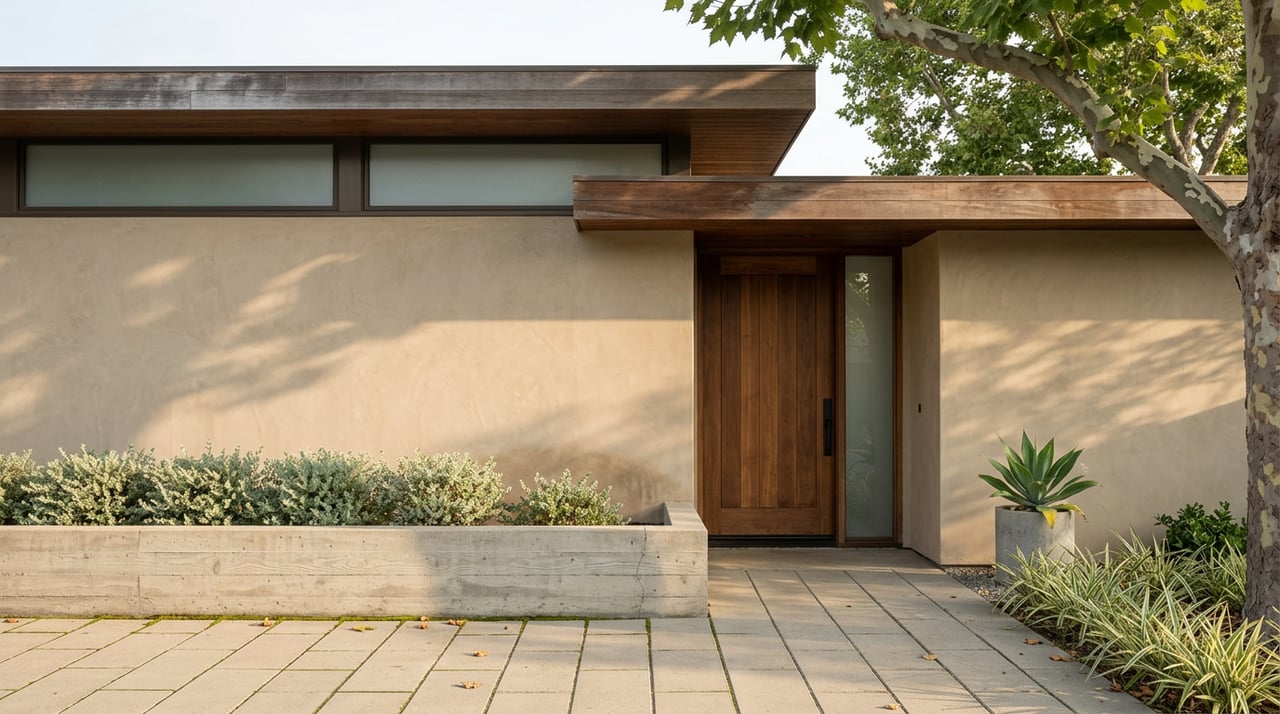
Tujunga Village Has Thrown the Same Party for Fifty Years. This Spring, It Started a Second One.
August 27, 2026
August 27, 2026
Walk Tujunga Avenue on a Saturday morning in December and you will find Aroma Cafe's regulars threading past a stage being wired for sound, string lights already up, someone testing a snow machine that has no business working in Los Angeles and does anyway. This has been the neighborhood's holiday fixture for so long that most people who live within walking distance of it were not alive for the first one. Walk the same block on a Saturday afternoon in May and you would have found something the street had never staged before: a wine garden run by Vitello's, roughly twenty vintage Porsches parked diagonally where cars are never allowed to sit, and more than thirty vendor booths filling in the gaps between them.
Those two afternoons, seven months apart, tell you more about what is happening on this one block than any list of coffee shops and boutiques ever could. One party is an institution. The other is a bet the block's merchants just placed on itself.
The Tujunga Village Holiday Block Party marked its 50th annual run in December 2024, which puts its origin around 1975. The event has kept its shape for half a century: Tujunga Avenue closes to cars between Moorpark and Woodbridge, the street turns into what organizers still call a "Shop + Dine + Stroll" evening, and the businesses that make up the corridor open their doors late while Santa works a photo line and a machine makes it snow on a street that averages maybe one real frost a year.
Fifty consecutive years of the same event on the same three-block stretch is not a small thing for a commercial strip this size. Plenty of Los Angeles shopping districts cycle through their anchor tenants and their marketing gimmicks every few years. Tujunga Village kept doing the same December night long enough that it became a fixture on the Studio City Neighborhood Council's own calendar, not just a merchants' promotion.
That kind of continuity usually means a block has settled into a rhythm and stopped experimenting. This year it did the opposite.
On Saturday, May 23, 2026, Tujunga Avenue closed again, this time from 1 p.m. to 8 p.m., for the inaugural Tujunga Village Spring Music Festival. It was not a scaled-down version of the December party moved to a warmer month. It had its own character and its own mechanics.
Vitello's ran a wine garden instead of just staying open late. Live bands played through the afternoon. Roughly twenty classic Porsches lined the street, a detail specific enough that it clearly came from an actual car club rather than a generic "vintage vehicle display" line item. More than thirty vendor booths filled in the rest of the block, alongside dog adoptions and free activities for kids.
The detail that says the most about how the merchants are thinking, though, is the incentive structure organizers built into the day:
That is not the structure of a one-off pop-up. It is a coordinated attempt to get customers to circulate through multiple storefronts in a single afternoon, tracked well enough that organizers knew who the first ten spenders were at each location. A Perrow Production drone flew overhead documenting the whole thing. None of that reads like a neighborhood association testing the waters. It reads like a group of business owners who compared notes, agreed on a shared promotion, and decided the block was ready to support a second flagship day on its calendar.
Whether the Spring Music Festival becomes an annual counterpart to the December party the way the December party became an institution is genuinely an open question. But the fact that a fifty-year-old holiday tradition and a brand-new spring festival now exist on the same three-block strip in the same year is itself the story.
Two headline events a year would leave a lot of dead months if that were the whole calendar. It is not. For several years running, the block has also hosted a Pinz Saturday Market on the second Saturday of most months, skipping December when the holiday party takes over that slot entirely. It is a smaller, quieter fixture than either flagship event, but it does the work of giving residents a reason to check the block more than twice a year rather than treating it as a place you visit only when there is a festival banner up.
That layering, a fifty-year institution, a new spring counterpart, and a recurring monthly market underneath both, is what separates an actual commercial rhythm from a strip that just happens to host events occasionally.
None of this works without the businesses that stay open for it. Aroma Cafe functions as the block's daily anchor regardless of what is happening on the calendar, the kind of place where a weekday morning line is normal and a Saturday festival crowd is just an extension of the usual traffic. Gelato Bar has held its corner long enough to be the stop people build an evening walk around rather than a destination on its own. Caioti Pizza Cafe and Girasol Restaurant give the block two distinct dinner options within a few doors of each other, one a longtime pizza counter, the other a New American kitchen tucked around the corner on Moorpark. Verona, the family-run boutique that turns its floor into a pop-up art space between selling seasons, is the kind of shop that makes a festival day feel like an extension of what it already does rather than a costume it puts on once a year.
Vitello's sits at the center of both flagship events for a reason beyond geography. A restaurant does not agree to run a wine garden for a citywide event, coordinate an open-late night twice a year, and stay a fixture for decades unless it has the kitchen capacity and the community standing to carry it.
The easy version of this story treats Tujunga Village as an undiscovered pocket that just happens to have good coffee and cute shops, the kind of framing that shows up in almost every write-up of this block going back more than a decade. That framing was never quite accurate, and it is even less accurate now. A block that has run the same event for fifty consecutive years is not hidden. It is established enough to have outlasted multiple decades of retail trends on Ventura Boulevard a few blocks south.
What changed this year is that the people running those storefronts decided fifty years of goodwill in December was not enough, and they were organized enough to build a second event with its own sponsors, its own incentive structure, and its own drone coverage. That is worth watching, not because it changes anything about property values or market timing, but because it tells you something about how much coordination currently exists among the merchants who define daily life on that block. Associations that can pull off a coordinated cross-shop spending incentive on their first attempt tend to keep building. If the Spring Music Festival returns in 2027, it will be worth noticing what they add next.
For now, the practical version is simple: check the Studio City Neighborhood Council calendar before assuming the only reason to walk Tujunga Avenue is the December party. The block just proved it has more than one reason a year to close the street.
If you are weighing a move to a Studio City block with this kind of texture, or you already live near Tujunga Village and want a read on how pockets like it are holding up in the current market, Abdo Pierre Faissal has spent years working these exact streets. Get in touch anytime you want a straight answer about what is actually happening a few blocks from home.
Stay up to date on the latest real estate trends.

Whether buying or selling, Abdo Pierre Faissal delivers a tailored strategy, expert negotiation, and a seamless experience from start to finish.
Get In Touch With Us
ABDO PIERRE FAISSAL | CA DRE# 02090175
The Agency | CA DRE# 01904054
ADDRESS
14140 Ventura Blvd Ste 101
Sherman Oaks, CA 91403